
Every resident has the right to feel safe walking through their neighbourhood, operating a business, using a park or taking their family downtown.
Today, too many people in Victoria do not feel that way.
Residents describe avoiding certain streets and public spaces. Business owners report theft, vandalism, threats and repeated property damage. Frontline workers face difficult and sometimes dangerous conditions. People experiencing homelessness, mental illness or addiction are also vulnerable to violence, exploitation and organized crime.
We should not accept this as inevitable. Nor should we reduce the issue to a false choice between public safety and compassion.
Victoria needs both.
My plan is to restore safe, welcoming public spaces while helping vulnerable people move toward housing, healthcare, treatment and stability.
Safety and compassion must work together
We do not have to choose between caring for vulnerable people and protecting the wider community. A responsible city does both.
Ignoring crime and disorder is not compassionate to residents, workers, business owners or the people living in dangerous conditions on our streets. At the same time, enforcement alone will not resolve homelessness, mental illness or addiction.
Victoria needs a balanced plan: visible safety resources, focused enforcement, cleaner public spaces, coordinated responses, accessible treatment and supportive housing, and transparent reporting of results.
One councillor cannot restore public safety alone. But I will champion this plan, ask hard questions, press every responsible level of government to act and insist that progress be measured openly.
Our public spaces belong to everyone. With practical leadership, clear accountability and coordinated action, Victoria can once again be a city where residents, visitors, workers and businesses feel safe and welcome.
The presence of trained personnel can discourage harmful behaviour, provide reassurance and ensure that problems are addressed before they escalate.
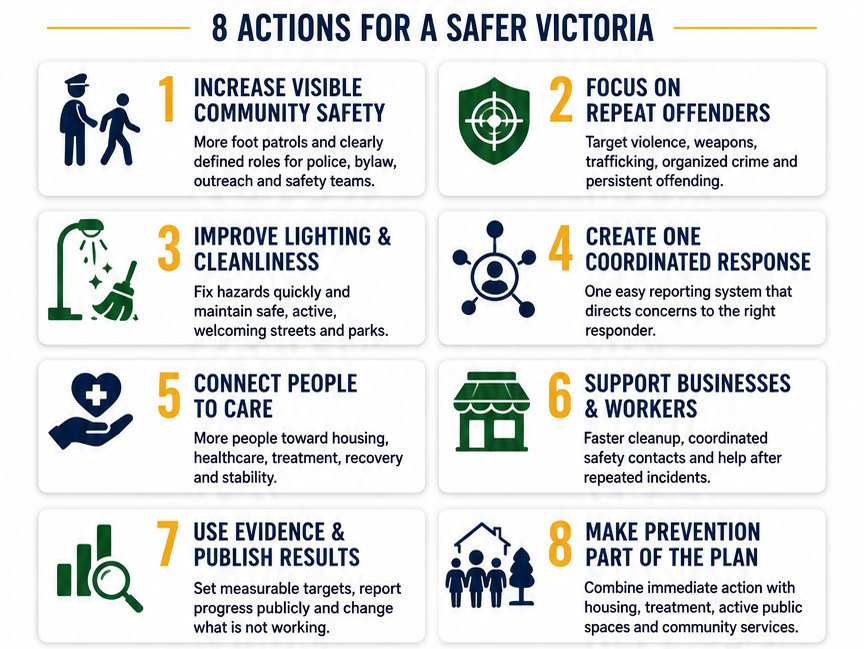
Victoria needs more visible foot patrols in areas experiencing persistent public disorder, including downtown commercial streets, parks, transportation corridors and other identified hot spots.
Police should concentrate on criminal activity, violence, weapons, trafficking, organized crime and repeat offenders. Trained community safety personnel can help with non-emergency concerns, wellness checks, directions, observation and connections to appropriate services.
Roles must be clearly defined so that police officers, bylaw staff, outreach workers and community safety teams are not duplicating one another’s work.
A relatively small number of individuals can be responsible for a disproportionate amount of theft, vandalism, violence and intimidation.
Victoria should work with the Victoria Police Department, Crown counsel, the Province and neighbouring jurisdictions to improve coordination around repeat offending and organized criminal activity.
We need better information sharing, consistent documentation and stronger advocacy for consequences and interventions that reduce repeated harm. People who commit serious or persistent offences must be held accountable.
Public spaces should not be surrendered to those who exploit vulnerable people or repeatedly victimize residents, workers and businesses.
The physical condition of a public space affects how safe it feels and how it is used.
Broken lighting, accumulated garbage, damaged infrastructure, graffiti and neglected streets signal that no one is responsible. Problems should be reported easily and resolved quickly.
The City should undertake a public space safety audit of priority areas and improve lighting where evidence shows it is needed. It should also establish clear response standards for graffiti, debris, broken fixtures, discarded needles and other hazards.
This is not cosmetic. Clean, well-maintained and active public spaces encourage positive use and improve confidence in neighbourhoods and downtown.
Residents and businesses are often uncertain about whom to contact. Police, bylaw enforcement, outreach teams, healthcare providers and nonprofit organizations may all be involved, but responsibility can become fragmented.
Victoria needs a coordinated public safety response model with clear roles, common priorities and shared performance measures.
A resident or business owner should not have to make several calls to find the right agency. The City should provide an easy reporting system that directs each concern to the appropriate responder and allows the person reporting it to understand what action was taken.
Coordination should also extend across municipal boundaries because crime, homelessness, addiction and mental-health crises are regional challenges.
Police officers and business owners cannot be expected to serve as the default mental health and addiction response system.
People in crisis need timely access to assessment, treatment, supportive housing and complex-care services. Outreach must lead somewhere. Moving people from one block or park to another does not solve the underlying problem.
Victoria should press the Province to provide the healthcare, treatment and supportive housing capacity our region needs. The City and CRD should help identify locations, remove unnecessary barriers and coordinate implementation—but provincial health responsibilities must be properly funded by the Province.
Compassion means more than tolerating suffering in public. It means helping people move toward safety, recovery and stability.
Small businesses should not be left alone to manage repeated theft, vandalism, threatening behaviour and cleanup costs.
The City should create a practical support program for businesses in high impact areas. It could include faster cleanup, coordinated safety contacts, advice on environmental design, improved reporting and targeted assistance following repeated incidents.
Frontline retail, hospitality, maintenance, security and outreach workers should also be included in safety planning because they often see emerging problems first.
Their experience can help the City direct resources where they will have the greatest effect.
Public-safety decisions should be based on reliable information, not slogans or selective statistics.
Victoria should publish a clear public dashboard that tracks:
- Violent and property crime
- Business break-ins and vandalism
- Calls for service
- Repeat hot spots
- Response times
- Public space cleanup requests
- Resident and business perceptions of safety
- Connections to housing, treatment and healthcare
- Repeat incidents involving the same locations
Police reported crime is important, but it does not tell the entire story. Many incidents are never formally reported. The City should combine official statistics with regular surveys of residents, businesses and frontline workers.
Council should establish me
Enforcement is necessary, but lasting public safety also depends on prevention.
Well used parks, active storefronts, youth programs, appropriate lighting, supportive neighbours and accessible community services can reduce opportunities for crime and disorder. Housing and treatment can help break the cycle of crisis, victimization and repeated emergency response.
Victoria should combine immediate action with long term prevention. We need to address dangerous behaviour today while reducing the conditions that allow it to continue.